
Intro
On July 25, 2026, we chained two critical vulnerabilities to compromise multiple OpenAI employees’ ChatGPT accounts. With these accounts, we could then access internal OpenAI repositories, and potentially many other connectors.
To prove we had in fact gained the access we believed without allowing ourselves to learn any sensitive information, we used the employee’s Codex to open a PR #1186742 in OpenAI’s internal monorepo openai/openai.
Exploit chain
Exploit timeline
-
We traced Discourse's HEIF upload path through ImageMagick to libheif and found the heap overflow.
-
Opus 4.8 got the first code-execution exploit working with ASLR disabled.
-
06:00 UTC
Opus 5 turned it into a reliable local image-upload exploit with ASLR on.
-
10:00 UTC
The code-execution exploit worked against our Discourse Cloud instance, then OpenAI's forum at community.openai.com.
-
13:30–15:30 UTC
We used an employee's Codex account to open a harmless PR in OpenAI's internal monorepo, then stopped testing.
Until July 25, 2026, any user or OpenAI employee logging into OpenAI’s own help forum (community.openai.com) could have had their ChatGPT and Codex accounts taken over. Since people can connect various services to Codex and ChatGPT, the scope of what we could theoretically access was huge, including GitHub, Slack and emails.
From finding the bug to reaching OpenAI’s internal repositories took less than 72 hours.
We immediately reported the initial vulnerability to OpenAI and Discourse and worked with them to coordinate the patch. OpenAI confirmed its fix about 14 hours after our report, and Discourse had a fix two days after we reported to it. OpenAI also paid us a $6,500 bounty.
Disclosure timeline
-
05:00–06:00 UTC
The Hacktron team obtained remote code execution (RCE) and administrative access to the Discourse environment hosted at
community.openai.com. -
08:00–10:00 UTC
After confirming the cross-product impact, the team coordinated internally on the responsible disclosure process and submitted a report through OpenAI's Bug Bounty Program on Bugcrowd.
-
13:30–15:30 UTC
We accessed an OpenAI employee's account and created a harmless proof-of-concept pull request in OpenAI's internal monorepo (link redacted at OpenAI's request). We updated the existing Bugcrowd submission with these findings, reached out to friends at OpenAI on Twitter/X to notify them directly, and ceased all further testing at approximately 15:30 UTC.
-
22:49:45 UTC
OpenAI replied to the report confirming its fix, roughly 14 hours after the initial submission.
-
We submitted a report to Discourse through its HackerOne program.
-
Discourse replied to the report on Sunday.
-
Discourse had a fix ready by Monday and added image-processing sandboxing as defense in depth.
-
Discourse published GHSA-vhm9-85gw-x335 with patch and rebuild guidance.
-
OpenAI paid a $6,500 bounty and marked the report resolved. It commented: "To clarify the scope of that award: testing against the Discourse-hosted community.openai.com was explicitly excluded from our bug bounty program. The award recognizes the OpenAI-side finding, not the actions against Discourse."
Background
A few months ago, our team at Hacktron, led by Harsh Jaiswal alongside Mohan Pedhapati and Rahul Maini, began researching frontier AI companies to find security vulnerabilities. This led us to discover an SSO misconfiguration in OpenAI’s identity infrastructure and a libheif RCE in the community forum used by OpenAI.
We’ve since expanded the research into HEIF Heist, a multi-month investigation tracing libheif across Slack, Meta, GitHub Enterprise, Ruby on Rails, and Node.js frameworks such as Next.js, Astro, and Gatsby. A surprising amount of widely-used software depends on this one image-processing library:
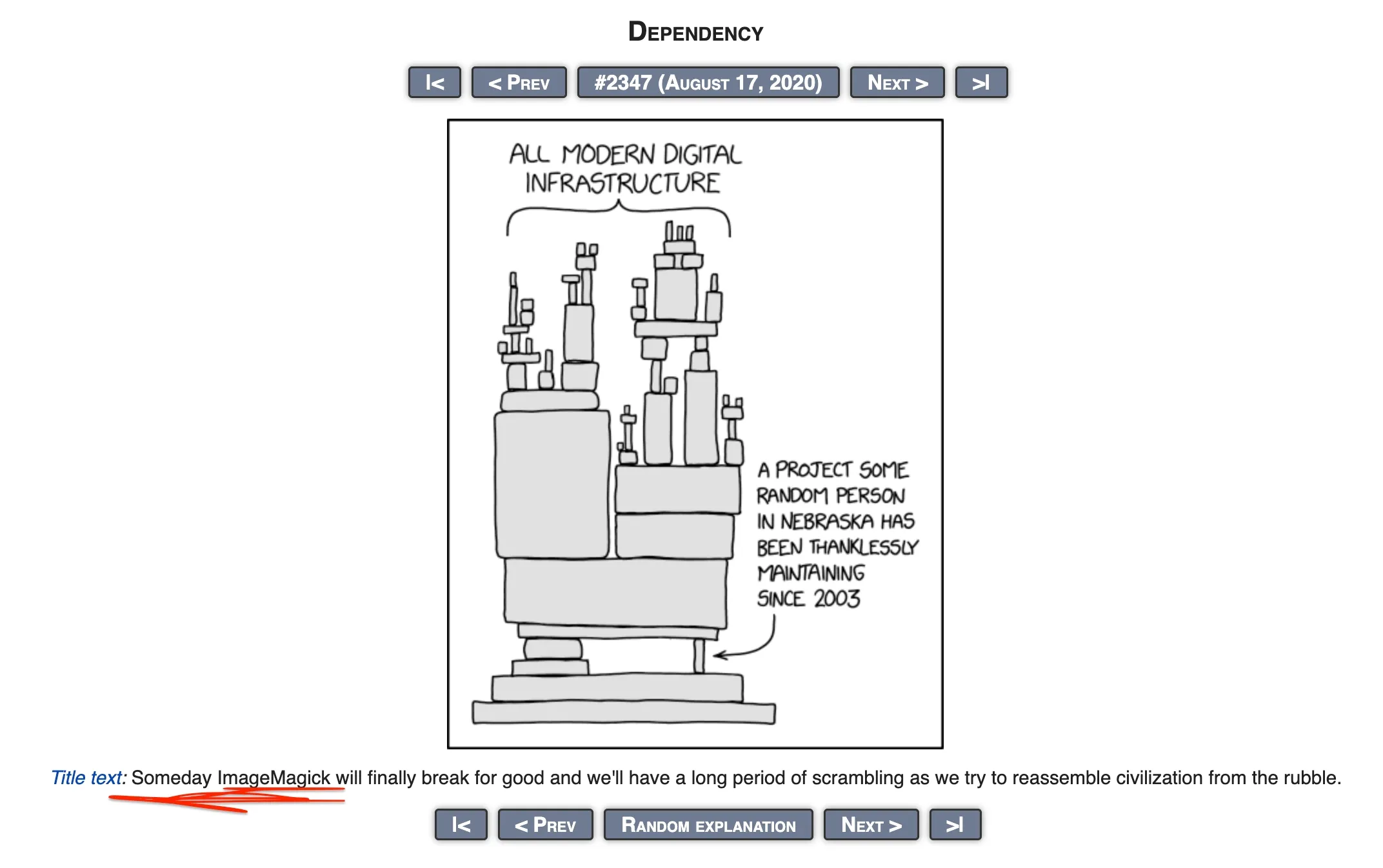
xkcd #2347, Dependency, a stack of blocks representing all modern digital infrastructure balanced on one thin block, with ImageMagick underlined in red in the title text
If your application processes user-controlled images and accepts .heic/.heif/.avif images, it is highly likely it is affected. Please reach out to us at hello@hacktron.ai if you need any kind of assistance.
Hacking community.openai.com
OpenAI uses Discourse for their forum and allows “Sign in with OpenAI” through auth.openai.com. After getting a good understanding of OpenAI’s services and infrastructure, we had reason to believe that compromising the forum could create a path into broader OpenAI services through this identity flow. To test that hypothesis, we first needed remote code execution on an OpenAI service like the Discourse community forum.
While the Discourse app itself is actually not an easy target (we have looked into it in the past), we thought we could go after a dependency.
Heap buffer overflow in libheif
On July 23, we started reviewing Discourse’s image-upload pipeline, and we found that HEIC and HEIF files followed an unusual path. Discourse normally used FastImage for image checks, but because FastImage did not support HEIF, it passed those files to ImageMagick’s magick command for conversion.1 That exposed the underlying libheif parser directly to attacker-controlled files.
We started an Opus 4.8 session with the Discourse Docker image and asked it to inspect the installed libheif package for security issues. After a while, it found that some particular security fixes were not back-ported to the libheif package. This allowed a heap buffer overflow leading to OOB R/W primitives during HEIC decoding.
The vulnerable code had been changed upstream the previous year, but the commit was not documented as a security fix and received no CVE.2 This might be a reason why Debian 12 and 13 have not received the security relevant backports in time. Because Discourse’s Docker image was based on Debian 12, it installed the vulnerable libheif version 1.19.7. Even Debian 13 still shipped the vulnerable version 1.19.8 at the time. Debian published its security update for Debian 13 on August 8, 2026.3
On July 24, we used Opus 4.8 to develop a working ImageMagick/libheif code-execution exploit with ASLR disabled. We then launched several separate sessions to make it reliable against Discourse’s default configuration with ASLR enabled, which wasn’t fruitful.
Opus 5 released
That evening, Anthropic released Claude Opus 5.4 We started a new session, which first produced a working ARM64 exploit for a local Mac within 3 hours. We then asked it to port the exploit to the x86-64 environment and jemalloc configuration used by Discourse.
By 6:00 a.m. on July 25, we had confirmed local RCE through an image upload. We then placed Claude in an autonomous /goal loop against our own Discourse Cloud instance, proxied through rce.ee/ctf-forum to make it look like a CTF target because Opus refused to write exploits for remote instances.
When we checked again at 10:00 a.m., the agent had achieved RCE on Discourse Cloud and demonstrated access by reading /etc/hosts. Using the generated exploit script, we managed to get RCE on OpenAI’s instance.
After we had confirmed our hypothesis of no interaction account takeover of ChatGPT/Codex accounts from active members of the forum, we immediately sent our report to OpenAI. We then took over an OpenAI employee’s account, whose Codex was connected to OpenAI’s GitHub organization. To demonstrate impact without actually accessing any internal code, we sent a prompt to this employee’s Codex account to open a PR for us in OpenAI’s internal monorepo. Then we stopped any further testing.
OpenAI asked us not to publish the original, so this is a reconstruction:
chatgpt.com/codex/cloud/tasks/task_b_6aa84cec00ec832199daa1fb0979caa3
Update README.md with new title
not-openai/openai +1 -3
Update README.md to “Hacktron AI team PoC”
Worked for 2m 7s
Summary
- Replaced the README contents with “Hacktron AI team PoC.”
- Committed the change in commit
1c12d2aand created the pull request metadata.
Testing
git diff --checkcat README.mdgit status --short --branch, working tree is clean.
README.md
# Not OpenAI MonorepoThis is not-OpenAI MonorepoHacktron AI team PoC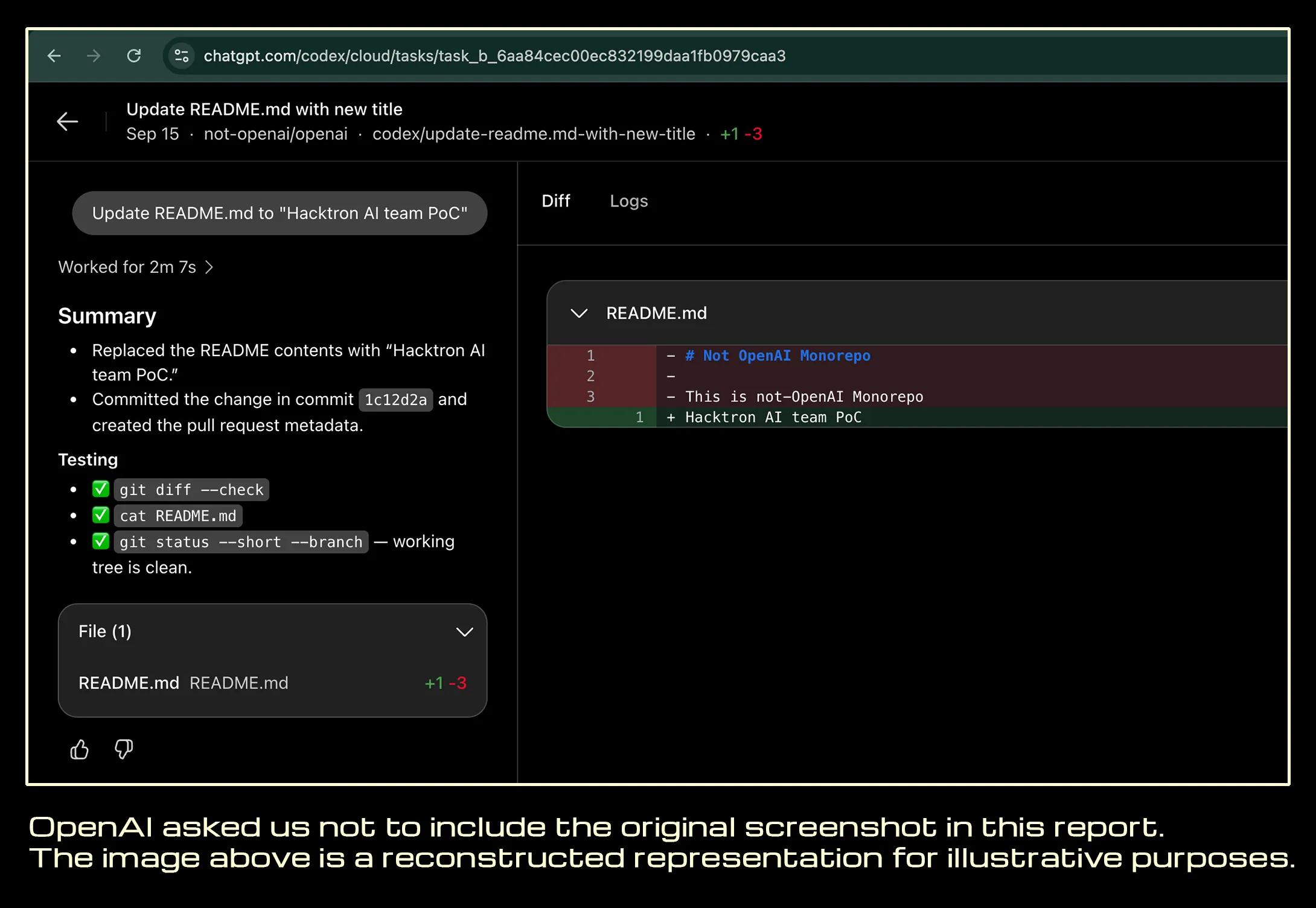
Reconstructed Codex task page for a README.md change in not-openai/openai, standing in for the redacted pull request in OpenAI’s internal monorepo
We updated the Bugcrowd submission with the impact proof and alerted OpenAI security. We also prepared a report for Discourse and reported it to their HackerOne program. Discourse received the report on a Saturday, replied on Sunday, and had a fix by Monday (kudos for speed). They also immediately started sandboxing ImageMagick.
The escalation bug is not specific to Discourse. It is an OpenAI SSO issue that turned the forum compromise into access to ChatGPT and Codex. If any first-party or third-party OpenAI service using the OpenAI SSO was compromised, it would lead to the same access. Discourse was one way to prove it.
Costs of finding these vulnerabilities
The Discourse and OpenAI hack took a few days for an agent, and just a few hours of human time. The whole HEIF Heist research project going after Slack, Meta, and more took two months, cost less than $3,000 in tokens in total, and was conducted by three researchers. Adapting the exploit to each new company usually took only one or two days.
Opus 4.8 struggled across several sessions to produce a working exploit with ASLR enabled. Within hours of Opus 5’s release, we gave it the same problem and it succeeded. Across the broader campaign, we saw another clear jump from Opus 5 to GPT-5.6 Sol, when we had to exploit the vulnerability without knowing anything about the target system besides that it’s vulnerable.
For each target, testing began with an image upload. From there, we turned memory corruption into a reliable memory leak or shell, usually without knowing the exact libheif version, libc version, or deployment environment. The AI started almost blind and adapted the exploit for each company within one or two days. We are not aware of any company that detected the activity except Shopify, even after thousands of images were sent and their image processors repeatedly crashed.
When code execution landed inside a sandbox or restricted environment, the models also helped with privilege escalation, lateral movement, and bypassing existing defenses. This was not completely autonomous hacking, and skilled human guidance remained important, but three researchers covered Slack, Meta, and the other targets in two months for under $3,000 in tokens.
Epilogue
Software has long benefited from a kind of security through complexity. The code and even the vulnerability could be public, but turning a bug into a reliable exploit still required rare expertise, significant time, and knowledge of the target environment. Known memory corruption vulnerabilities were expensive to operationalize, while zero-days were mostly reserved for the highest-value targets.
This was never a real security boundary, but it protected ordinary companies in practice from software vulnerabilities. AI is removing that protection by turning more of this scarce expertise into compute. Work that once required a well-resourced team and months of effort can now be compressed into days.
A realistic threat model should take into account the economics of exploitation today, instead of relying on outdated assumptions5 about who can carry out sophisticated attacks.
Versions affected and patches
HEIF Heist is not tied to a single version. It covers vulnerabilities across multiple release families (e.g. 1.19.x, 1.20.x, 1.22.x, 1.23.x). Any deployment lacking the latest upstream security patches is potentially vulnerable.
Install the latest security-patched
libheifandlibde265packages through your distribution’s security channel or an upstream release. As of September 14, 2026, the latest upstreamlibheifsecurity release is v1.23.4; v1.23.2 has been superseded by further security fixes. Distribution packages may carry backported fixes under an older upstream version number, so check the package security advisory as well.6 3Given the complexity of the ISO base media file format and the pace of decoder updates, future memory-safety flaws are likely. As defense in depth, production architectures should disable untrusted HEIF/AVIF decoding where it is not needed, or isolate image-processing pipelines inside hardened, ephemeral sandboxes. ImageMagick’s security policy supports restricting accepted formats and resource usage.7
Acknowledgements
We thank Sudanshu Rajhbhar for technical assistance, and Zayne Zhang, Fabian Faessler, Robert Chen, and Jessica Ruan for proofreading, reviewing drafts, and providing feedback that improved this post.
Work with the team behind this research
Hacktron’s team includes top CTF researchers and red teamers. We use AI to accelerate security research, finding and eliminating vulnerabilities in widely trusted software before malicious actors do. We’re continuing our research across frontier labs and other internet-critical systems. If you’re responsible for securing one of them, we’d like to work with you.